
How to Build a Danish CV
The CV that got you interviews back home probably will not here. Here is what Danish employers actually look for, and how to build yours in an afternoon.
When we first moved to Aarhus, we both sent out the same CVs we had used back home. Clean, one page, no photo, formal language, achievements in bullet points. We heard nothing back for weeks. Eventually a Danish friend looked at one of them and immediately said: "Where is your photo? And why does this read like a legal document?" That was the moment it clicked: a Danish CV is not just a foreign CV translated into a slightly different format. It is built on a completely different set of assumptions about what employers want to know about you.
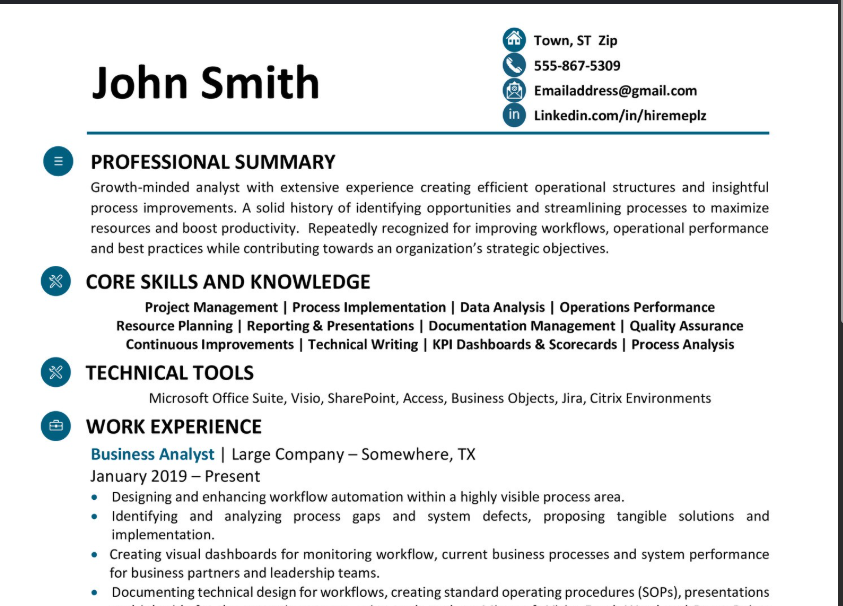
Before getting into the specifics, there is a framework worth understanding first. It will make everything else make sense.
Your CV has one job: to get you an interview
HR screeners at larger companies have been shown to spend as little as twenty seconds on a CV before deciding whether to read further. It is impossible for them to absorb every detail. So the only goal of your CV is to make a good enough first impression that someone invites you in. After that, the interview is where the real work begins.
Think of your CV as a presentation sheet, not your complete story. It is a door opener, nothing more.
One CV per role, and here is why it actually matters
You have probably heard the advice to tailor your CV for each role. This is especially important in Denmark for a specific reason. Modern hiring systems, particularly at larger companies, use Applicant Tracking Systems (ATS) that filter applications by keywords before a human ever reads them. If your CV does not contain the right language from the job posting, it may never reach a person at all.
The good news is that AI has made tailoring CVs significantly faster than it used to be. What once took a full day can now be done in minutes across multiple applications.
A word of caution here though, and this is something we have both learned from personal experience: AI can hallucinate. It may invent details, get facts wrong, or subtly misrepresent your experience in ways that are hard to catch on a quick read. One of us once used AI to research a company for a cover letter and got the deal size and date completely wrong. An analyst spotted it immediately in the interview. We somehow recovered, but it nearly ended the application on the spot. Always review everything AI produces line by line, especially any specific facts, figures, or company references. Your CV and cover letter need to be yours, with AI used as a drafting aid, not a replacement for your own judgment.
The other trap with AI-assisted applications is volume without relevance. It is easy to send hundreds of applications simply because it has become easy to do so. You will find people online saying "I sent 200 applications and got nothing back." The reason is usually that they were not thinking carefully about whether the role was actually relevant to them, or whether the company was one they had any genuine interest in. Danish employers want to hire a person, not a profile. Sending a generic application to every open posting signals the opposite of that.
The anatomy of a strong Danish CV
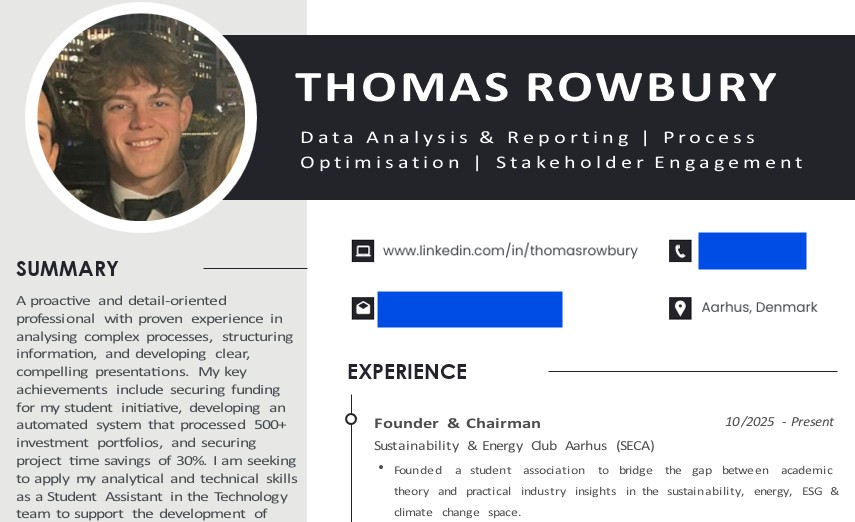
Use a clean, modern layout. Canva has good free templates that work well for this.
Always include a photo, unless the job posting specifically says otherwise. This is completely normal in Denmark and often expected. Use a clear, friendly, professional photo. Nothing overly formal, nothing too casual.
Use your headline strategically. If the role title is "Student Assistant," put that exact phrase next to your name at the top. It increases the chance of catching a hiring manager's eye immediately.
Include a short summary section: who you are, what you are studying, and which of your skills are specifically relevant to this role. Keep it to three or four lines.
List your work experience in reverse chronological order, newest first. The key here is not just listing what you did, but connecting it to the role you are applying for. Applying for a sales assistant role? Emphasise communication and stakeholder experience. Applying for a data role? Highlight anything involving numbers, reports, or analysis. The same experience can be framed differently depending on what you are applying for.
If you have no formal work experience yet, this is harder but not impossible. Highlight school projects, volunteer work, or any context where you took on responsibility. Include your grades if they are strong, since it gives the hiring manager an additional data point. And if you are struggling to land your first student role, consider applying for very simple entry-level positions first, even basic data entry or warehouse work. It gives you the employer validation that makes the next application easier. Sometimes the first job is just about getting a foot in the door.
Put Danish first in your languages section, above your native language, even if you are only on Module 1. A willingness to integrate is genuinely important to Danish employers. It signals that you are investing in being here for the long term, not just passing through. If you are not yet taking Danish lessons, start. It will make a material difference.
Include a short hobbies or about me section. This is one of the most distinctly Danish parts of a CV. Whereas formal CV conventions in many other countries treat personal interests as optional filler, Danish employers actively want to know who you are outside of work. Do you play sport? Have an unusual hobby? A specific passion? Put it here. Keep it brief, two or three lines, but make it genuine. This is not the place for "I enjoy reading and socialising." Tell them something real.
The single most common mistake
Sending the same CV to every job without changing anything. Not because it is lazy, though it is, but because it signals to a Danish employer that you have not thought carefully about why you want to work specifically for them. Danish hiring is personal. The CV that gets you an interview is the one that feels like it was written for this job, at this company, not assembled from a template and fired out to fifty places at once.
Was this helpful?